How We Saved a Chemical Plant's Glass Lined Reactor — Without Replacing It
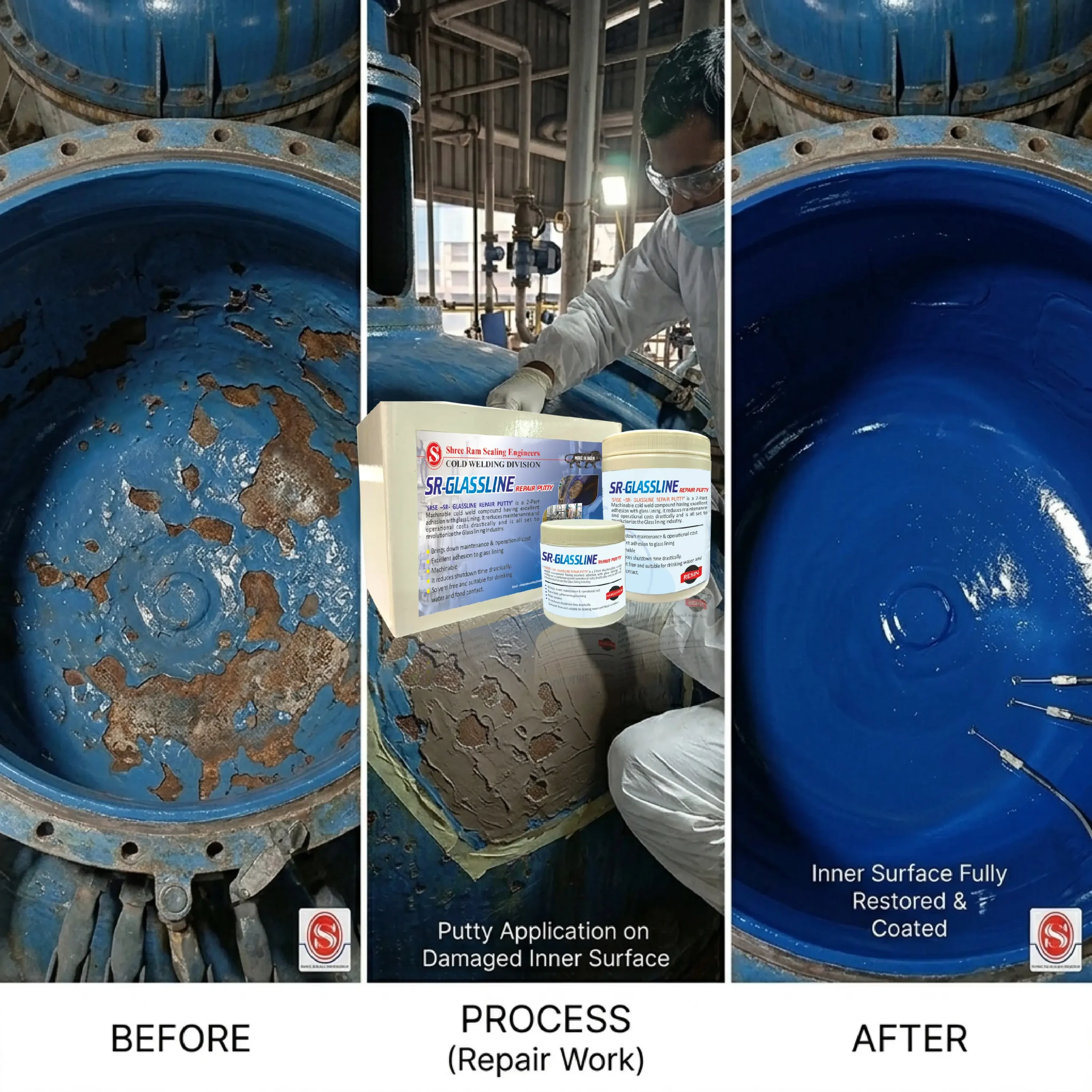
A chemical plant in Vapi, Gujarat was facing a serious problem. One of their most important production vessels — a Glass Lined Reactor (GLR) — had started showing signs of internal damage. Small pits and chips had appeared on the glass lining inside.
For any chemical plant, this is not a small issue. The glass lining is there for one critical reason: to protect the steel body of the reactor from highly corrosive chemicals. Once that lining starts to fail, the damage spreads fast. Left untreated, it can mean complete equipment failure, costly reactor replacement, and weeks of lost production.
The client needed a solution — fast, reliable, and without taking the reactor out of service for months.
That’s where Shree Ram Sealing Engineers came in.
Glass Lined Reactors are used in industries like pharmaceuticals, agrochemicals, and specialty chemicals — anywhere that processes aggressive acids, alkalis, or solvents. The internal glass coating acts as a barrier between the chemicals and the carbon steel body.
When we inspected the reactor at the Vapi plant, here is what we found:
- Small pits and pinholes in the glass lining — localized but spreading
- Exposed base metal in some areas — already at risk of chemical attack
- Surrounding glass lining still intact — making full re-glazing unnecessary but a localized repair urgent
- No option for long-term shutdown — the plant needed the reactor back in service within the maintenance window
The traditional fix for a damaged GLR is to send the vessel to a furnace and re-glaze the entire interior. This works — but it takes weeks, costs a significant amount of money, and means long production downtime. For a running chemical plant, that is simply not always possible.
The client asked us one question: Can you fix this on-site, reliably, and within our scheduled maintenance window?
Our answer was yes.
We used our proven SR Glassline Repair System — a multi-stage repair process developed specifically for glass-lined equipment. The system uses advanced polymer technology to fill, bond, and protect damaged areas, restoring the reactor’s internal surface to a chemically resistant and structurally sound condition.
Here is exactly how we carried out the repair, step by step.
Phase 1 — Surface Preparation (The Most Important Step)
Before any repair material is applied, the surface must be perfectly prepared. This is the step that most people underestimate — but it is the one that determines whether the repair lasts for years or fails in weeks.
Our team thoroughly cleaned the damaged areas inside the reactor. We removed all contaminants, grease, loose glass particles, and corrosion products. The edges of each pit were carefully prepared to create a clean, bondable surface. This roughening process ensures that the repair putty locks in mechanically — not just chemically.
No shortcuts were taken here. A proper repair starts with proper preparation.
Phase 2 — Structural Filling Using SR Glassline Repair Putty (Adhesive Grade)
Once the surface was ready, we applied SR Glassline Repair Putty in its adhesive grade formulation.
This is a high-viscosity, two-component putty engineered for exactly this application. It bonds directly to both the glass surface and the exposed metal underneath — filling the pits completely and creating a solid, seamless plug.
- High adhesion to smooth glass surfaces — no peeling or lifting
- Bonds directly to exposed base metal — seals the substrate from chemical contact
- High viscosity — stays in place on vertical and curved internal surfaces
- Cures to a hard, durable finish — can be leveled and feathered to match the surrounding lining
Each pit was filled carefully. The putty was worked into the damaged area to eliminate air pockets and ensure full contact with the substrate. After application, the material was allowed to cure fully before the next phase began.
Phase 3 — Inner Side Coatings for Chemical Protection
Filling the pits was only half the job. The repaired areas also needed to be protected against the same chemical environment that caused the original damage.
After the putty was fully cured and the surface was leveled, our team applied multiple layers of high-performance inner-side coatings over the repaired zones.
- Chemical resistance: The coating system is formulated to withstand both acidic and alkaline pH ranges — common in chemical and agrochemical processing
- Thermal stability: The repair holds up during heating and cooling cycles that reactors go through in normal operation
- Thickness matching: Multiple layers were built up to match the thickness and durability of the surrounding original glass lining
- Full coverage: The coatings extended slightly beyond the repair edges to create a smooth, sealed transition with the intact lining
The result was a repaired surface that looked, felt, and performed like the original — chemically protected, thermally stable, and mechanically sound.
A repair is only as good as the verification process behind it.
Once the final coating layer was cured, we carried out a thorough visual inspection of all repaired zones. The repaired areas were checked for surface uniformity, edge adhesion, and complete coverage of the damaged zones.
Holiday testing — a spark test used to detect any pinholes or discontinuities in a protective coating — was performed on the repaired surface. The reactor passed with 100% spark-free integrity across all repair areas.
Only after this verification was completed did we sign off on the repair and hand the reactor back to the client.
Here is what Shree Ram Sealing Engineers delivered for this Vapi chemical plant:
✅ Reactor returned to full service within the scheduled maintenance window — zero unplanned downtime
✅ Complete protection of exposed metal substrate — no further chemical attack possible
✅ Chemically resistant inner surface restored — reactor fully operational with aggressive process chemicals
✅ Significant cost savings — the client avoided full reactor re-glazing (furnace process) and vessel replacement
✅ Long-term service life extended — the repair is designed to hold up through years of normal thermal and chemical cycling
✅ 100% spark-free integrity confirmed on final holiday test
Cost Saving Breakdown
To give you a sense of the value delivered:
- Full reactor re-glazing (furnace): 3–6 weeks downtime + ₹5–15 lakh cost (vessel size dependent)
- Reactor vessel replacement: Months of downtime + very high capital expense
- SR Glassline On-Site Repair: Completed within the maintenance window at a fraction of the cost
For a running chemical plant, time is money. Every day of unplanned production downtime has a direct cost. Our repair eliminated that risk entirely.
Not every repair material can do this job. Glass-lined equipment presents unique challenges because:
- The glass surface is extremely smooth — most adhesives cannot bond to it properly
- The operating environment involves strong acids, alkalis, and solvents at elevated temperatures
- Thermal cycling means the repair material must expand and contract at a similar rate to the surrounding glass — or it will crack and detach
SR Glassline Repair Putty is formulated specifically to overcome each of these challenges. That is why it performs where general-purpose epoxy putties fail.
- Superior glass adhesion — bonds to smooth glass surfaces without mechanical anchoring alone
- Full chemical resistance across wide pH range — tested for common agrochemical and pharmaceutical process environments
- Thermal stability — maintains adhesion and integrity through repeated heating and cooling
- Application flexibility — can be used on horizontal, vertical, and curved internal surfaces
- Fast cure time — does not delay maintenance schedules
Vapi is one of India’s most important industrial zones — home to a large cluster of chemical, pharmaceutical, and specialty materials manufacturers. The plant involved in this project operates in the multinational agrochemical and specialty chemical sector, using Glass Lined Reactors as critical production assets.
We have been serving industrial clients across Gujarat, Maharashtra, Rajasthan, and Pan-India for over 16 years. Our team understands the specific demands of chemical processing environments — and we carry the materials and expertise to handle repairs at site, within your schedule.
If your GLR or glass-lined vessel is showing any of the following, do not wait until it becomes a bigger problem:
- Visible pits, chips, or cracks in the internal glass lining
- Rust staining or discolouration on the reactor wall
- Product contamination that was not present before
- Sparking or failure on a holiday test
- Unusual corrosion in the process batch
Early-stage damage is always easier and cheaper to repair than advanced damage. A small pit today can become a corroded substrate failure in weeks if the chemical environment is aggressive.
Contact Shree Ram Sealing Engineers for a free on-site assessment. We will tell you honestly whether a repair is the right solution — and if it is, we will carry it out within your maintenance window.
Shree Ram Sealing Engineers has been repairing and protecting critical industrial equipment across India for over 16 years. We serve chemical plants, power stations, refineries, food processing facilities, and more.
Our SR Glassline Repair Putty system is available both as an on-site repair service and as a direct product supply for your in-house maintenance team.
Q1: Can a glass lined reactor be repaired on-site without removing it?
Yes. In most cases of localized damage — pits, chips, and pinholes — a glass lined reactor can be repaired on-site using SR Glassline Repair Putty without removing the vessel. The repair is done during your scheduled maintenance window. Full re-glazing in a furnace is only needed when damage is extensive across the entire lining.
Q2: How long does a glassline reactor repair last?
When carried out correctly with proper surface preparation, SR Glassline Repair Putty repairs are designed for long-term service. The system withstands thermal cycling and the chemical environments common in pharmaceutical, agrochemical, and chemical processing. Exact service life depends on the operating conditions.
Q3: What is holiday testing in glass lined reactor repair?
Holiday testing (also called spark testing) is an inspection method where a high-voltage probe is passed over the repaired surface. Any pinhole or discontinuity in the coating will cause a visible spark, identifying areas that need re-treatment. A 100% spark-free result confirms the repair has complete integrity.
Q4: How much does glass lined reactor repair cost compared to re-glazing?
On-site repair using SR Glassline Repair Putty typically costs a small fraction of full furnace re-glazing. Re-glazing can involve 3–6 weeks of downtime, logistics costs, and significant labour and furnace charges. On-site repair is done within your maintenance window — saving both cost and production time.
Q5: Does SR Glassline Repair Putty resist acids and alkalis?
Yes. SR Glassline Repair Putty is formulated to resist both acidic and alkaline environments across a wide pH range. It is suitable for reactors processing pharmaceutical intermediates, agrochemicals, and specialty chemicals.
Q: Which industries use glass lined reactor repair services?
Glass lined reactor repair is commonly needed in: pharmaceutical manufacturing, agrochemical production, specialty chemicals, fine chemicals, dye and pigment manufacturing, and food-grade chemical processing.